
Institutional procurement · Transport evidence
Retatrutide Research Shipments: Decide What Transport Evidence You Need Before Dispatch
A temperature alarm is a reason to hold a shipment for assessment, not a complete verdict on the material.
For an institutional research project, agree before dispatch who will review an excursion, which records must accompany the delivery, and what evidence could support acceptance.
Ordering a routine purity retest first can spend the sample without resolving the transport question.
- Published
- Updated
- By
- LUMIRABIO Editorial Team
- Reading time
- 7 min read
Key Takeaways
- Exposure records and tolerance evidence answer different questions.
- Define the retesting question before consuming the sample.
- Separate technical disposition from commercial remedies.
Separate the three decisions
First, determine whether the proposed research supply is permissible for the institution and destination. Second, agree on the transport conditions and required evidence for that specific material. Third, assess the actual delivery against the agreed scope. A passing analytical result does not settle the first decision, and an intact box does not settle the third.
For this article, “quarantine” means holding material out of research use under the receiving institution’s procedure while the decision is unresolved. It does not imply a particular GMP certification or regulatory release system.
Decide the evidence package before choosing the shipping option
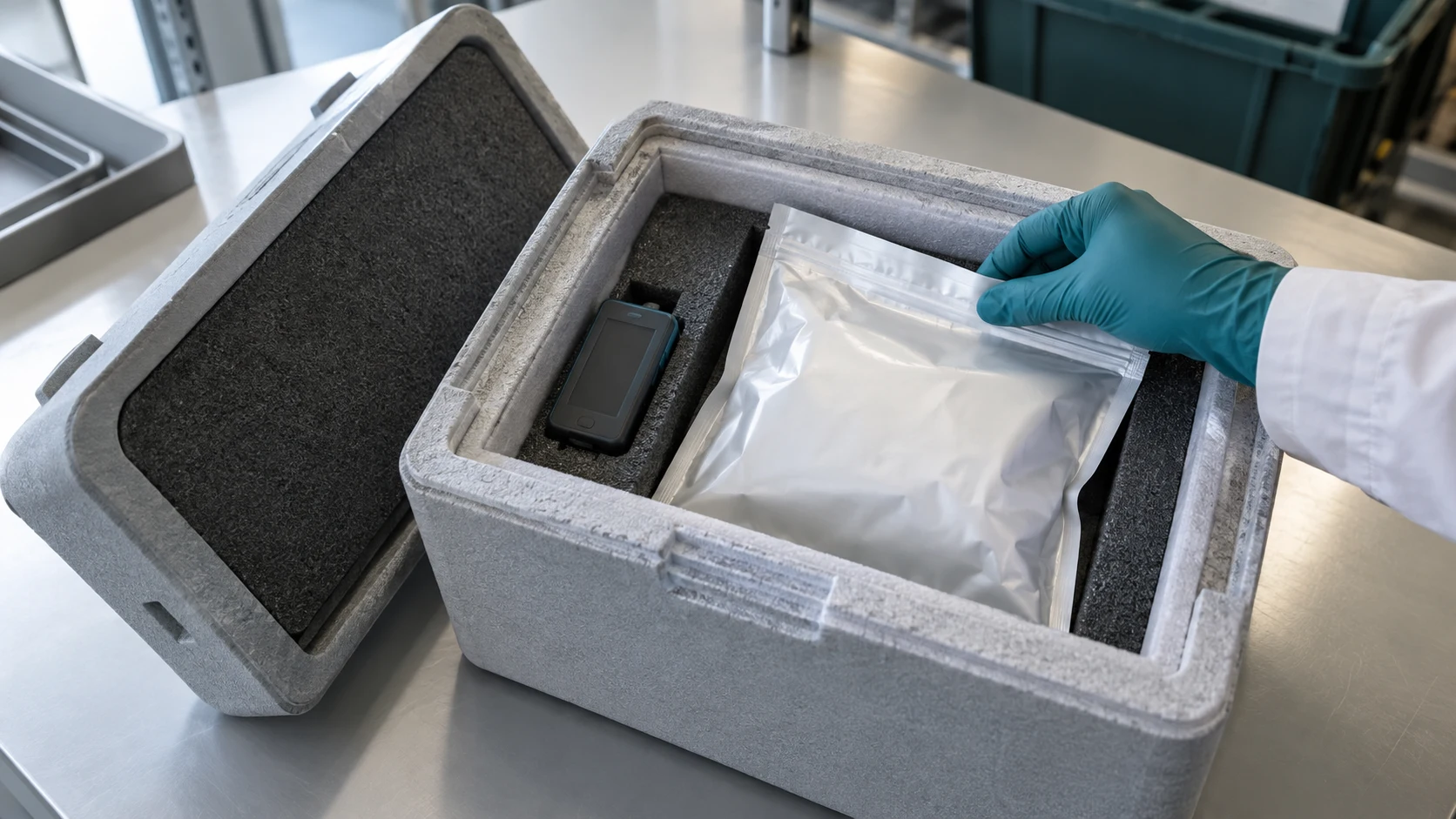
Ask for the proposed shipping configuration and its technical rationale alongside the quotation. Compare what each option establishes, rather than treating a refrigerated service as automatically better or an ambient service as automatically adequate.
| Proposed option | Evidence to request | Tradeoff to resolve |
|---|---|---|
| Defined packaging and route with monitoring | Applicable transport limits, recording interval, logger placement, handoff coverage and excursion contact | Monitoring documents exposure; it does not establish the material’s tolerance |
| Defined packaging and route without continuous monitoring | Basis for the configuration and route, coverage limitations, and the agreed response to delays | Less direct evidence of actual exposure may leave more uncertainty |
| Configuration without a documented rationale | Missing material/packaging evidence and a plan to resolve it before dispatch | Price and a promised delivery date do not replace the missing basis |
These are comparison questions, not approved options for Retatrutide. Do not assume that data from a finished medicine, another peptide, a solution, or a different container represent the proposed research material. ICH Q1A(R2) treats packaging and short excursions as relevant parts of stability evaluation for new drug substances and products.[2] Its registration context is a general reference here, not an automatic requirement for every research sample.
When delivery differs from the agreement
Record receipt time, shipment identity and the observed discrepancy before changing the evidence. Preserve original logger files and courier events; distinguish measured values from a recipient’s estimate. A reading from the outside of a box should not silently become the temperature of its contents.
Hold the affected material under the institution’s applicable handling procedure. Do not invent a universal freezer setting or attempt to “reset” the history by returning it to storage. Contact the technical decision owner and the agreed supplier contact. Ask what the available evidence covers and what it does not.
WHO’s transport-monitoring supplement connects exposure records with the limits supported by product stability data.[3] That distinction is useful: records tell you what was observed; applicable studies help interpret it. Neither a logger alarm nor a supplier’s generic reassurance answers both questions alone.
Decide whether retesting can reduce the uncertainty
Before commissioning tests, state the question: identity concern, change relative to a pre-dispatch result, a particular degradation risk, or suitability for the planned research? Ask the analytical lead which method addresses it and what it may miss. The analytical-testing article explains why identity, chromatographic purity and content are different results.
A single retest result cannot reconstruct missing transit history. Conversely, incomplete monitoring does not prove that degradation occurred. Retesting may contribute to a justified decision when its methods, sampling and comparison basis fit the question; it is not automatically sufficient or automatically pointless.
Allocate sample consumption and testing cost before proceeding. Keep responsibility for the technical conclusion separate from decisions about replacement, freight reimbursement or other commercial remedies. Those remedies depend on agreed terms, not on this checklist.
An editable exception record
Copy these fields into your institution’s workflow:
If evidence remains insufficient, record that explicitly. Do not convert “not shown to be damaged” into “shown suitable.”
- Shipment/lot identifier; supplied form and container; relevant agreement version.
- Dispatch and receipt timestamps with time zones; documented route and handoffs.
- Agreed transport conditions and supporting reference.
- Observed exception; logger identity, placement, coverage and original-file location.
- Known facts, estimates and missing periods, recorded separately.
- Available pre-dispatch comparison records, methods and dates; gaps or limits in the comparison.
- Technical question; proposed tests and their limits; retained/consumed sample.
- Decision owner; supplier response; acceptance, continued hold or rejection rationale.
- Commercial follow-up owner and closure date.
A supplier question to send before dispatch
“For institutional project [reference], please confirm the proposed supplied form, packaging and route; the evidence supporting the transport conditions; the monitoring coverage; and the contact and decision process for a delay or excursion. Please identify how supporting studies represent the supplied material and container, any limits to that comparison, and who approves testing or disposition. We need the technical rationale separately from delivery and replacement terms.”
This template is an editorial tool, not a company promise or a substitute for institutional approval. Bring the agreed project scope to a technical inquiry rather than asking for a generic shelf-life assurance.
Sources and Publication Record
Next decision
Include transport evidence in the project scope
Share a non-confidential institutional project outline to discuss records and responsibilities to confirm.
Related reading
More on Procurement and Project Planning


Retatrutide Material Identity: Define the Supplied Form Before Comparing Specifications
6 min read

Semaglutide API Documentation: Batch and Specification Review
6 min read