
Analytical review
Retatrutide Analytical Testing: Identity, Purity and Content
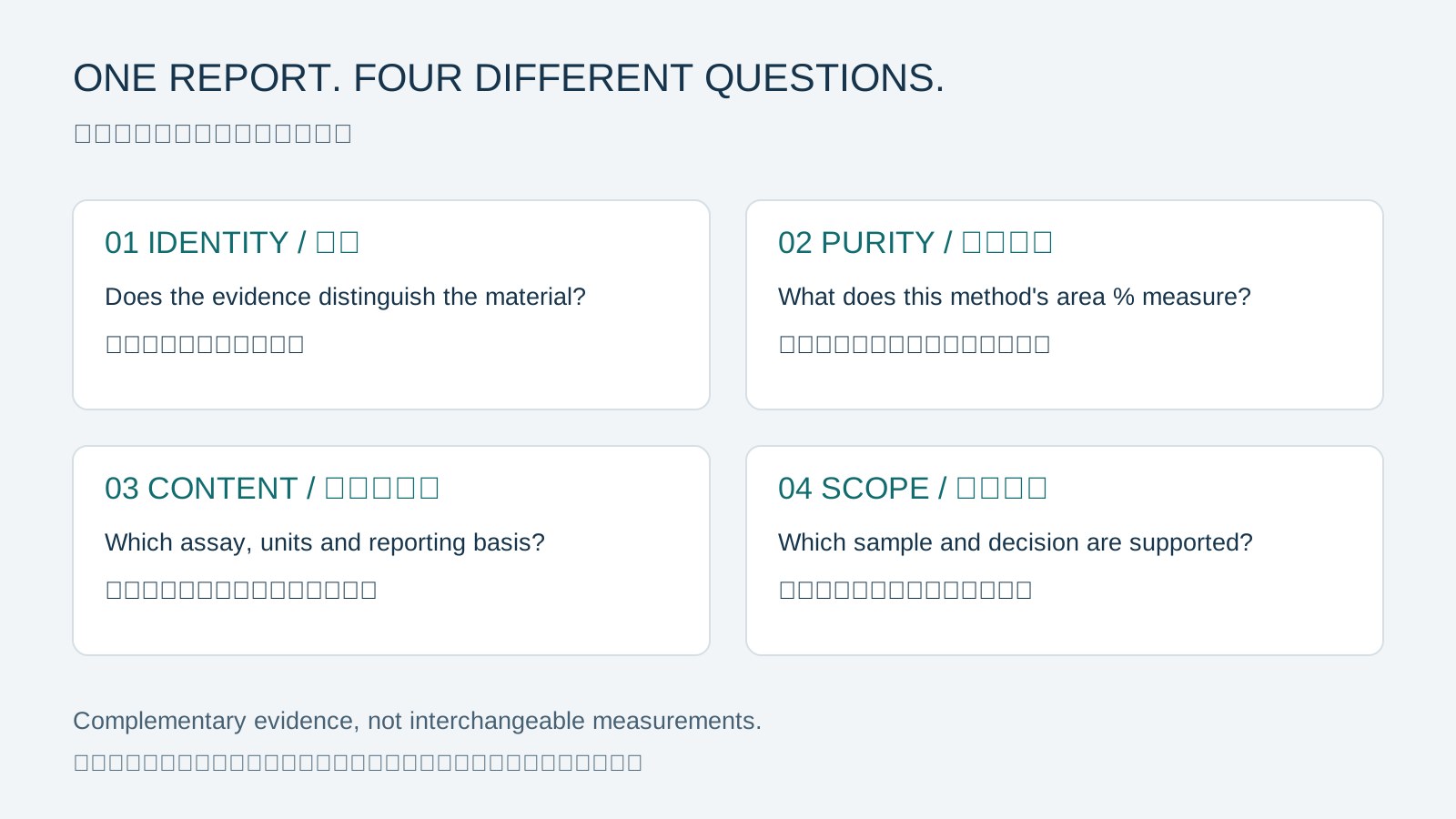
Retatrutide test reports should answer four questions. What was tested? How does the method identify it? What does the purity percentage measure? How was peptide content measured?
A high HPLC area percentage does not answer all four.
Start by linking each result to its sample, test method and reference material.
- Published
- Updated
- By
- LUMIRABIO Editorial Team
- Reading time
- 6 min read

Key Takeaways
- HPLC area percentage is not a target-specific mass fraction.
- Identity, content and impurity coverage answer different questions.
- Connect each result to its sample, method and reporting basis.
Four questions to keep separate
| Question | Evidence to examine | What not to infer |
|---|---|---|
| Is it the intended material? | An appropriate identity strategy and characterized reference material | A matching retention time alone proves complete structure |
| What does the purity result measure? | Separation, detector response, integration and method suitability | HPLC area percentage equals the target's share of total powder mass |
| How much target material is present? | A defined quantitative method, reference assignment, units and reporting basis | Net peptide content and target-specific assay are interchangeable |
| Does the package support this decision? | Relevant impurity coverage, sample linkage and justified acceptance criteria | A good analytical result automatically qualifies the supplier or shipment |
Use this table to allocate questions to the right reviewer. Procurement can establish which documents are available; analytical specialists should assess whether those documents support the claimed measurement. The broader supplier decision is covered in our Retatrutide supplier-qualification review.
1. Read HPLC purity with its method
For UV-detected chromatography, area normalization describes the main integrated peak relative to the integrated peaks included in the calculation. It is a detector- and method-dependent result. Bachem's peptide quality-control guide distinguishes this measurement from peptide content and separately discusses water, counterions and residual solvents.
Ask for the method identifier and version, chromatogram, detection conditions, integration rules and relevant suitability evidence. The point is not to demand every development record at the first conversation. It is to understand what was measured before comparing numbers from different reports.
As a purely illustrative example, a report displaying “99% area” does not by itself establish that 99% of the weighed sample is the target molecule. Components can respond differently to the detector; some may not be adequately separated or detected. A clean-looking main peak is therefore a starting observation, not a complete description of the material.
For two laboratory reports, first reconcile the sample and methods. A difference between reported percentages may warrant investigation, but the percentages alone do not show whether the material changed or the methods measure differently. Record the question that remains unresolved rather than ranking laboratories from the headline number.
2. Match identity evidence to the structural question
GenScript describes using both analytical HPLC and mass spectrometry in peptide quality control, illustrating why complementary evidence matters. The relevant question for an institutional Retatrutide review is whether the chosen identity approach addresses the proposed material and the differences that need to be distinguished.
Avoid treating “MS confirmed” as a complete explanation. Ask which test produced the result. Check the reference or expected value used. Then ask which differences the method can detect. An intact-mass match alone does not resolve every possible structural distinction. Choose further tests based on the molecule and process risks. A checklist for a different peptide may not cover those risks.
EMA's synthetic-peptide guideline addresses characterization, specifications and analytical control within its stated scope. Its relevance must be assessed for the particular development program; citing it is not evidence that a batch meets an agreed specification.
Reference material also needs context: its identity, assigned value where relevant, storage and suitability for the measurement. A familiar compound name on a reference label does not replace that assessment.
3. Define content before comparing quantities
The word “content” can hide different calculations. A total or net peptide-content result can include peptide-related material other than the intended target. A target-specific assay asks a different question. Water, counterions and residual solvents also affect how the composition of a weighed material is described.
Before comparing results, identify the units and basis: for example, whether a percentage is reported as received or after a defined correction. Ask which reference value and correction factors were used. Keep the original reporting basis visible when transferring results into a project spreadsheet.
Do not automatically multiply HPLC area percentage by a net peptide-content figure and call the result a validated target assay. Whether such a calculation is defensible depends on the methods, selectivity, response assumptions and compatible reporting bases. Request the justification instead of using a universal conversion shortcut.
For Retatrutide material discussions, define the exact proposed form and the information needed for the project. This article does not assign a salt form, molecular formula or content value to any supplied batch.
Before comparing records, define the proposed material and reporting basis; see Retatrutide material identity, supplied form and specification review.
4. Connect the result to its intended decision
ICH Q2(R2) provides a framework for analytical procedure validation, while ICH Q14 addresses analytical procedure development. They help frame the evaluation of methods rather than prescribing a single Retatrutide test panel.
A useful review begins with the decision the result must support. Is the team characterizing a development sample, comparing material, investigating a difference, or assessing an agreed specification? The necessary evidence may differ. Explain method limitations and unresolved questions in terms of that decision.
Our peptide impurity-control overview provides context for discussing different analytical questions. Do not assume a method used for one purpose establishes stability, controls every relevant impurity, or covers microbiological attributes. Those conclusions require their own applicable evidence.
When the question concerns a shipment delay or excursion, agree what transport records and applicable material evidence are needed before deciding what a retest can establish; see Retatrutide research-shipment transport evidence.
5. Ask five questions before accepting the package
These are review prompts, not universal release criteria. A sample result supports conclusions about the tested material within the method's scope. Extending those conclusions to a batch or shipment requires an appropriate sampling and traceability justification.
For a project discussion, prepare a non-confidential description of the intended material, development stage, target market and analytical questions. Use the technical inquiry route to establish what can be reviewed. Project-specific documentation and responsibilities should be confirmed through the appropriate technical exchange.
- Which sample, material form and batch does each report identify?
- Which method and version produced the result, and what was the method intended to measure?
- What reference material and reporting basis support identity or quantitation?
- What relevant questions remain outside the method's demonstrated coverage?
- Who will resolve the gaps, and what evidence is needed before the project decision?
Before ordering external testing, use the delivery-scope matrix with your receiving team to agree reports, files and access.
Sources and Publication Record
Next decision
Define the analytical questions for your project.
Share the intended material, project stage and target market in a non-confidential brief.
Related reading
Continue the Exhibition and Sourcing Review

Retatrutide API Supplier Qualification: A 7-Step Review Beyond the CoA
7 min read

FDA Import Alert 66-80: What GLP-1 API Buyers Should Verify in 2026
11 min read

Six Peptide Drug Development Signals R&D and CMC Teams Should Watch in 2026
11 min read